
NAVIEN TANKLESS WATER HEATERS
Why Does My Navien Tankless Water Heater Go Cold During a Shower?
Why does a Navien tankless water heater go cold during a shower? Learn about flow, temperature settings, scale, winter conditions, safe checks, and when to call a qualified Long Island technician.
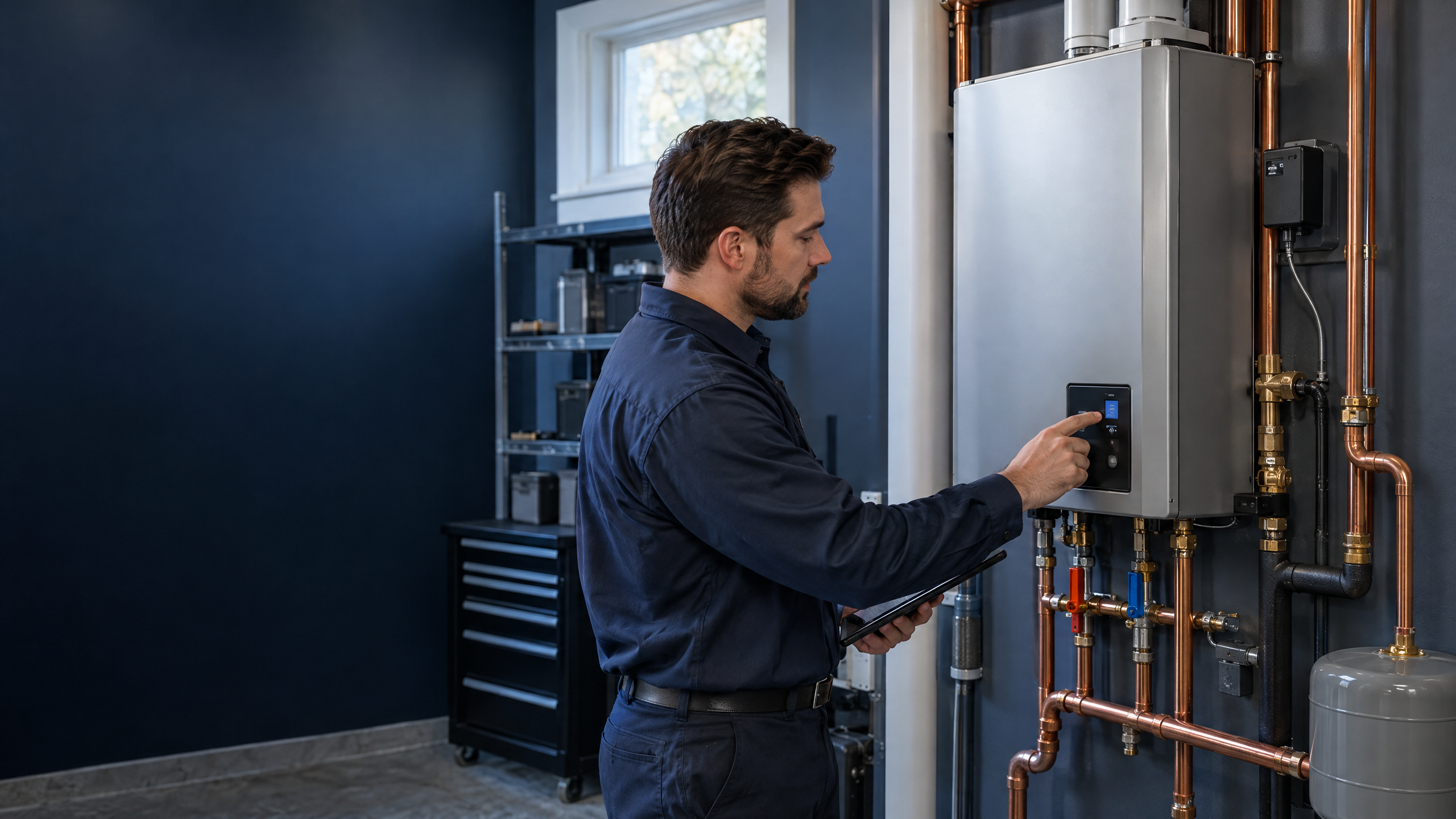 Editorial image · For illustration only
Short answer: A Navien tankless water heater can go cold during a shower when the hot-water flow falls below the unit’s operating threshold, the temperature setting and flow do not match the demand, mineral scale or a dirty filter restricts flow, or the unit has a model-specific fault. A cold burst that keeps happening needs a qualified technician—not repeated resets or changes inside the unit.
Start by noting whether the water goes cold when another fixture opens, whether the flow is weak, whether the display shows a code, and whether the problem happens at one fixture or throughout the home. Do not open the cabinet, adjust gas pressure, change venting, bypass a safety control, or work on wiring.
Why does a tankless water heater go cold during a shower?
The shower flow may be too low
Navien explains that a tankless unit needs a minimum flow to keep operating. A low-flow showerhead, partially closed valve, clogged fixture screen, or mixing issue can reduce hot-water flow enough for the burner to stop. The result may feel like the heater is “running out” of hot water even though the cause is flow, not a storage tank being empty.
The temperature setting may not match the demand
Navien notes that a higher unit temperature setting can mean less hot water is needed at the fixture because more cold water is mixed in. If the hot-water portion becomes too small, flow through the heater may fall. The safe setting depends on the home, occupants, fixture, and model. Do not change settings repeatedly to chase the symptom; ask a qualified professional to evaluate the setup.
Scale or a restricted filter can reduce flow
Navien’s maintenance guidance identifies inlet water filters, air filters, condensate components, and heat-exchanger flushing as maintenance items. Mineral buildup can reduce water flow and interfere with operation, especially where water hardness is a factor. Annual maintenance is recommended by Navien, with frequency affected by water quality and the installed model.
Cold-weather or freeze-related conditions may be involved
Cold weather itself does not automatically make a properly sized tankless heater stop delivering hot water. Navien warns that tankless units can freeze in certain installations or during a power outage, especially when freeze protection cannot operate. If pipes, the unit, or the mechanical room may be frozen, stop using the equipment and call a qualified professional rather than applying improvised heat.
A model-specific fault may be shutting the unit down
An error code, sensor issue, ignition problem, water-flow fault, venting issue, or another internal condition can interrupt heating. The exact meaning depends on the Navien model and installation. Record the code and call for service; do not bypass a lockout or safety control.
What can I safely check before calling?
- Confirm whether the cold water affects one shower or every hot-water fixture.
- Note whether another faucet, toilet fill, dishwasher, or washing machine is using water at the same time.
- Record the displayed temperature, error code, and whether the water becomes cold immediately or after several minutes.
- Observe whether hot-water flow is weak, pulsing, or normal before it turns cold.
- Check only for accessible signs of leaking water, freezing, or water near electrical equipment. Do not remove covers.
Do not open the cabinet, adjust gas or combustion settings, alter venting, change wiring, bypass a safety control, or flush a heat exchanger unless the exact manual and a qualified professional make the procedure appropriate. Navien’s maintenance information also warns that improper work can damage the unit or affect warranty coverage.
When should I call immediately?
Leave the area and call 911 or the gas utility as appropriate if you smell gas, a carbon-monoxide alarm sounds, anyone has headache, dizziness, weakness, nausea, confusion, or unusual sleepiness, there is smoke or fire, or water is reaching electrical equipment. The CPSC recommends getting outside to fresh air immediately and calling 911 when CO poisoning is suspected, and recommends working CO alarms on every level and outside sleeping areas.
If there is no immediate emergency but the water repeatedly turns cold, the unit shuts down, an error code returns, or the home has no reliable hot water, schedule qualified Navien service promptly.
Questions homeowners often ask
Is the tankless heater out of hot water?
No. A tankless unit heats water as it flows. A cold shower usually points to flow, temperature, scale, installation, or a fault—not an empty storage tank.
Should I turn the temperature higher?
Do not use a higher setting as a blanket fix. It can change the hot-to-cold mixing ratio and create a scald risk. Have the model, fixture flow, and system setup evaluated.
Can I descale it myself?
Follow the exact owner’s manual and local requirements. Because service involves isolating, draining, and flushing equipment, many homeowners should use a qualified Navien technician, especially if the cause is not clearly a routine maintenance need.
Next steps for a Long Island homeowner
Record the symptom, flow behavior, display code, and affected fixtures, then contact a qualified Navien water-heater professional. For service planning, see Navien water-heater service and installation, review Long Island service areas, or request a free estimate. You can also read what repeated Navien boiler pressure loss can mean if your system is a boiler or combi-boiler.
Sources
Navien: Tankless Water Heaters & Cold Climates
Navien: Tankless Water Heater Maintenance Tips
U.S. Consumer Product Safety Commission: Carbon Monoxide Safety
This article is general homeowner information, not a diagnosis or a substitute for the installed model’s manual, applicable codes, or an on-site evaluation by a qualified professional.