
NAVIEN BOILER TROUBLESHOOTING
Why Does My Navien Boiler Keep Losing Pressure?
Why does a Navien boiler keep losing pressure? Learn what repeated pressure loss can mean, what to observe safely, and when to call a qualified Long Island technician.
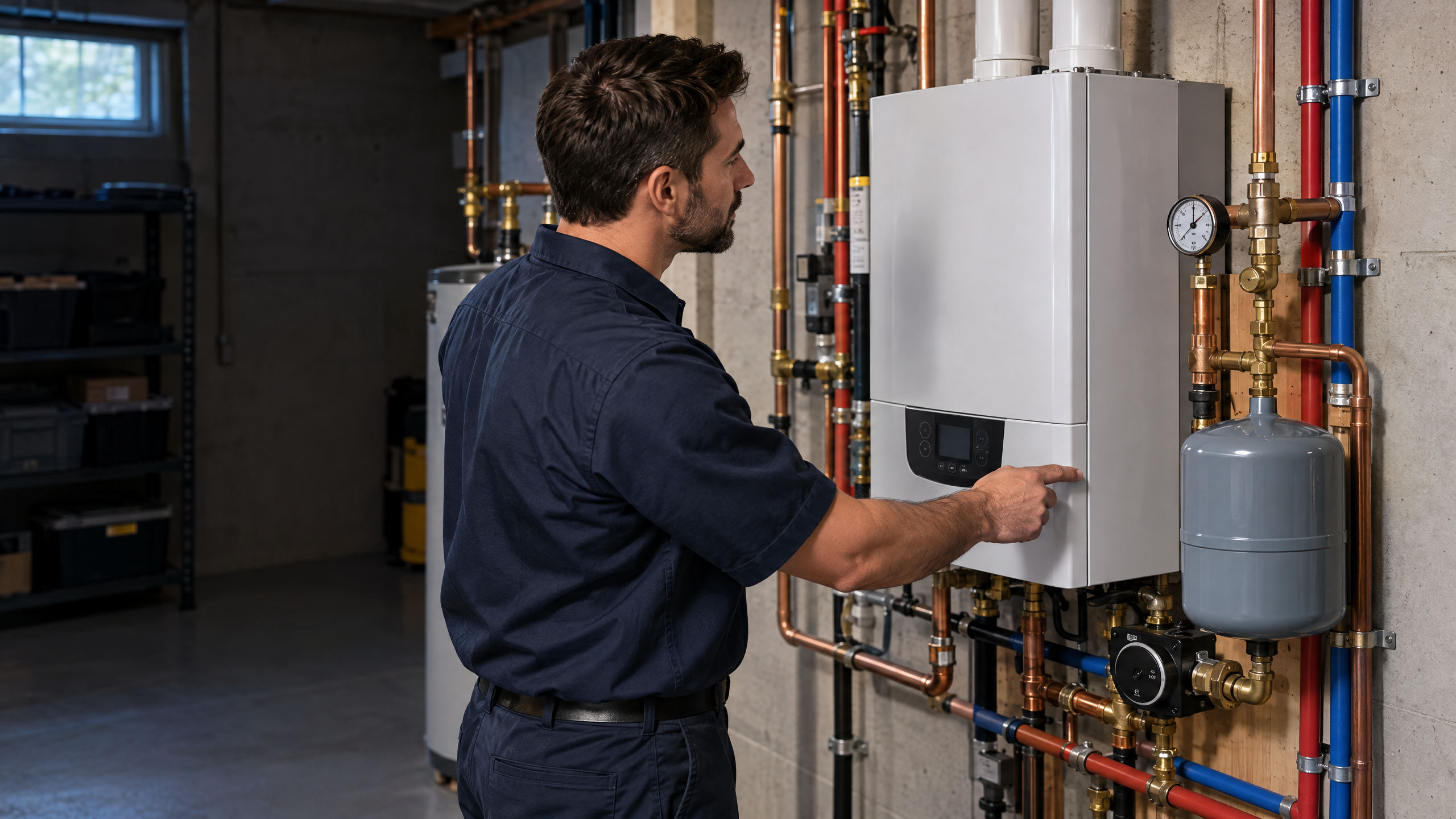 Editorial image · For illustration only
Short answer: A Navien boiler that keeps losing pressure usually has a water-side problem somewhere in the heating system, such as a leak, pressure-relief discharge, expansion-tank issue, air-related problem, or another component that needs professional diagnosis. Repeated pressure loss is not something to solve by repeatedly adding water or changing boiler settings. Call a qualified technician.
For a Long Island homeowner, the useful first step is to document what the gauge or display shows and when the pressure drops. The next step is a professional inspection—not opening the cabinet, adjusting gas or combustion settings, or bypassing a safety control.
What does low boiler pressure mean?
Hydronic heating systems circulate water through the boiler and distribution system. When the system loses water or cannot maintain stable pressure, the boiler may display a low-pressure warning, stop heating, make unusual noises, or provide inconsistent heat. The exact acceptable range and user actions depend on the installed Navien model and the system design, so the owner’s manual and a qualified technician—not a generic internet number—should control.
Why does a Navien boiler keep losing pressure?
A leak in the heating loop
A small leak may occur at an accessible pipe joint, radiator connection, circulator area, drain point, or another part of the hydronic loop. Water can evaporate or collect out of sight, so the absence of a puddle does not prove there is no leak. Repeated pressure loss deserves a professional search for the source.
Pressure-relief discharge or expansion-system trouble
The pressure-relief system and expansion tank help protect a hot-water heating system as water temperature changes. The U.S. Department of Energy’s HVAC guidance identifies pressure-relief-valve and expansion-tank checks as technician maintenance tasks for hot-water systems. Do not test, cap, adjust, or replace these components yourself.
Air, recent service, or a system issue
Air in a hydronic system, recent work, a filling problem, or a circulation and control issue can be part of the diagnosis. These possibilities can look similar from the homeowner’s point of view, which is why repeatedly resetting or refilling the system can hide the underlying problem or create a safety concern.
A model-specific fault or component problem
Navien boilers and combi-boilers vary by model and installation. A display code, sensor reading, heat-exchanger issue, automatic fill problem, or another component may require the exact manual and trained diagnostic equipment. Navien’s service-document warning says service and repair work should be performed by qualified and properly licensed professionals.
What can I safely observe before calling?
- Write down the boiler model, display message or error code, and when the pressure warning appears.
- Note whether pressure changes when the system is heating, after it shuts down, or overnight.
- Look only at accessible areas for visible water, staining, corrosion, or dripping near exposed piping. Do not remove panels.
- Check whether the home has heat and hot water, and whether any rooms or zones are affected.
- Take a photo of the display and gauge for the technician.
Do not open the boiler cabinet, adjust the fill valve, operate a relief valve, change gas or combustion settings, alter venting, work on wiring, or bypass a lockout or safety control. If the manual permits a specific owner-level check, follow that manual exactly; otherwise call for service.
When is low pressure an emergency?
Leave the area and call emergency services or the gas utility as appropriate if you smell gas, a carbon-monoxide alarm sounds, anyone has symptoms such as headache, dizziness, nausea, or confusion, there is smoke or fire, or water is actively reaching electrical equipment. Do not re-enter until the appropriate emergency or utility professional says it is safe. The CPSC has documented that gas-fired boiler venting failures can create a carbon-monoxide poisoning hazard and advises consumers to use working CO alarms.
If there is no immediate emergency but the boiler repeatedly loses pressure, has no heat during cold weather, or shuts down, call a qualified Navien technician promptly. Do not keep resetting or refilling it as a substitute for diagnosis.
Questions homeowners often ask
Can I just add water to raise the pressure?
Do not repeatedly add water unless the installed model’s manual specifically allows a simple owner-level action and you understand the limits. If pressure keeps falling, adding water treats the symptom while the cause remains. Call a qualified professional.
Is low pressure the same as a boiler leak?
Not necessarily. A leak is one possible cause, but relief discharge, expansion-system problems, air, filling issues, or model-specific faults can also be involved. A technician needs to evaluate the system.
Can low pressure cause no heat?
It can be associated with a shutdown or heating problem, but the display, system design, and symptoms matter. Do not assume the pressure reading alone identifies the cause.
Next steps for a Long Island homeowner
Record the display and gauge, keep people away from any active leak or unsafe equipment, and contact a qualified Navien service professional. For service planning, see Navien boiler repair and installation, review Long Island service areas, or request a free estimate.
Sources
Navien official downloads and service-document safety warning
U.S. Department of Energy HVAC: A Guide for Contractors to Share with Homeowners
U.S. Consumer Product Safety Commission gas-boiler carbon-monoxide hazard notice
This article is general homeowner information, not a diagnosis or a substitute for the installed model’s manual, applicable codes, or an on-site evaluation by a qualified professional.