
NAVIEN BOILER EFFICIENCY & TROUBLESHOOTING
Why Does My Navien Boiler Keep Turning On and Off?
Why does a Navien boiler keep turning on and off? Learn what short cycling can mean, what to observe safely, and when a qualified Long Island technician should evaluate the system.
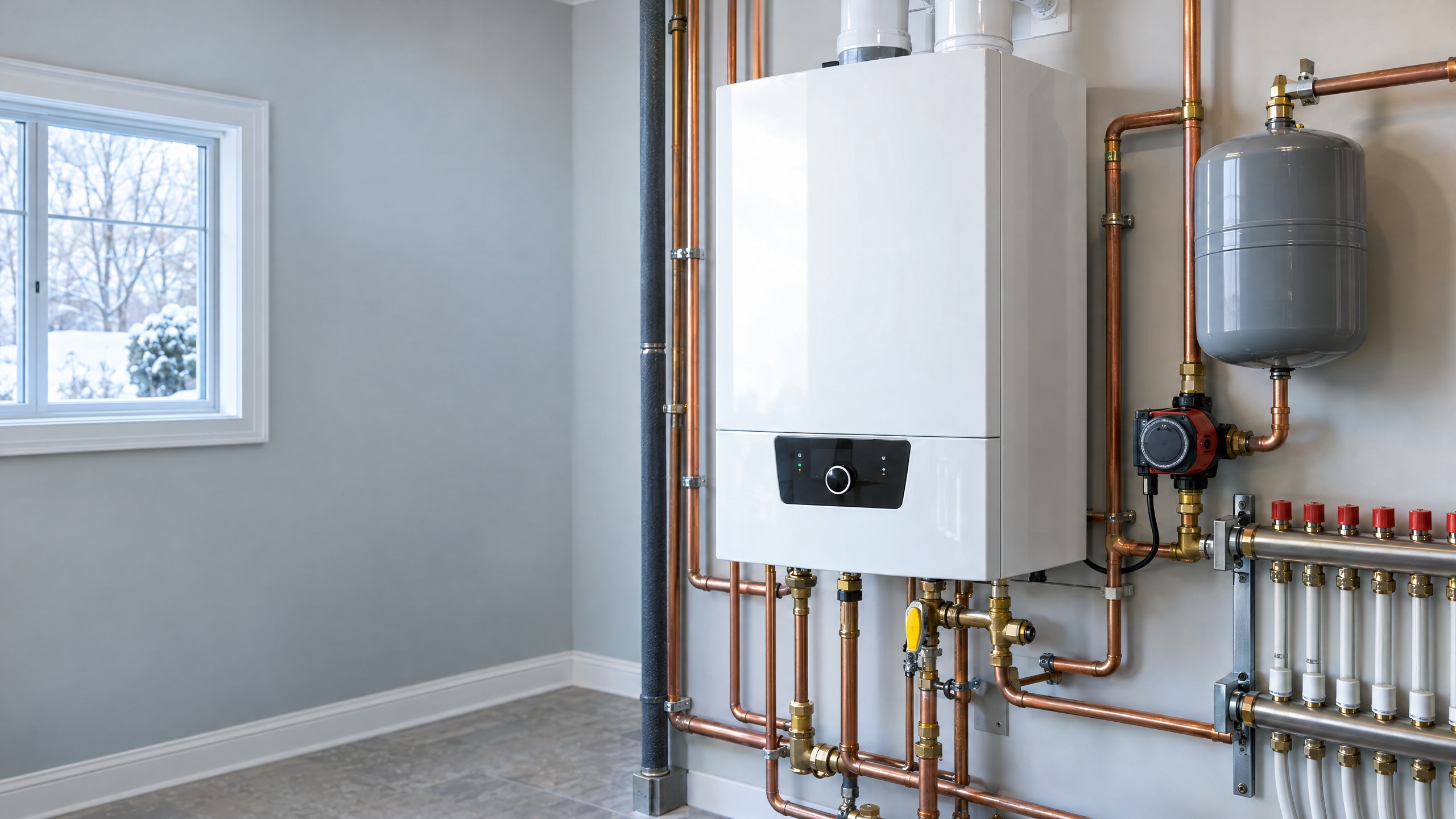 Editorial image · For illustration only
Short answer: A Navien boiler that starts and stops repeatedly may be short cycling. The cause can be a heating load that is smaller than the boiler output, low demand during mild weather, thermostat or control behavior, restricted circulation, zone configuration, or a model-specific fault. Frequent cycling is not a reason to change settings inside the boiler. Document the pattern and have a qualified technician evaluate the appliance and system.
For a Long Island homeowner, the useful question is not simply how many times the boiler fires. Note how long each run lasts, whether the home reaches the thermostat setting, which zones are calling, what the display shows, and whether the pattern changes with outdoor temperature. Do not open the cabinet or adjust gas, combustion, electrical, venting, or safety components.
What is boiler short cycling?
The U.S. Department of Energy describes short cycling as a boiler quickly satisfying the heating demand and then shutting down until heat is required again. A normal heating cycle has a startup, firing period, shutdown or purge, idle period, and another call for heat. Short cycling means the firing periods are unusually brief or the starts and stops happen much more often than the system needs.
Some cycling is normal. A boiler should not run continuously in every condition, and a modulating boiler may change its firing rate as demand changes. The concern is a new, frequent, or disruptive pattern that affects comfort, efficiency, noise, or reliability.
Why does a Navien boiler keep turning on and off?
The boiler output may not match the current heat demand
A boiler sized for a colder design day may satisfy a small heating demand quickly during mild weather. Oversizing is one recognized cause of short cycling. Navien explains that turndown allows a boiler to operate at lower output levels and more closely match the home’s heat demand. The right conclusion for a particular home requires a heat-loss review and an evaluation of the installed model and controls.
Thermostat, control, or zone behavior may be involved
A thermostat call, sensor, outdoor reset control, zone valve, circulator, or wiring problem can change how the system responds. A small zone may call for less heat than the boiler can modulate down to. A thermostat located near a heat source or affected by drafts can also end a call earlier than expected. Do not change wiring or control settings as a test.
Water circulation may not be removing heat normally
Navien says air in a boiler system can cause overheating or prevent pumps from circulating water. Restricted flow, a valve or circulator issue, air, or another water-side problem can make the boiler reach its temperature limit quickly and stop. These are diagnostic and service issues, not homeowner adjustments.
A combi-boiler may be switching between heating and hot-water demand
Navien combi-boilers prioritize domestic hot water when a faucet, shower, or appliance creates demand. A household using hot water can therefore interrupt space-heating operation. That is different from repeated short cycles during a steady call for space heat, but the timing can look similar from the homeowner’s perspective.
A model-specific fault may be interrupting operation
A display code, sensor condition, ignition problem, venting issue, overheating protection, or another fault can stop a firing cycle. The meaning depends on the exact Navien model and installation. Record the message or code and contact the original installer or a Navien Service Specialist rather than repeatedly resetting the unit.
What can I safely observe before calling?
- Time several cycles from ignition or startup to shutdown, without opening the boiler or touching controls.
- Note whether the thermostat is calling for heat and whether the home reaches the requested temperature.
- Record which rooms or zones are affected and whether the pattern changes when other zones call.
- For a combi-boiler, note whether the starts and stops occur during showers, faucet use, laundry, or dishwasher use.
- Write down the model, display message, error code, and any unusual noise or visible water near accessible piping.
- Note whether the behavior is new or occurs only during mild weather, cold snaps, or after a service visit.
Do not change the thermostat differential, alter boiler temperature or firing settings, open the cabinet, adjust gas or combustion controls, modify venting, work on wiring, bleed or drain the system, change relief or expansion components, bypass a lockout, or defeat a safety control. Navien states that internal components should be serviced by a qualified contractor.
Can short cycling damage or reduce efficiency?
Frequent cycling can waste energy and increase wear because each cycle includes startup, purge, shutdown, and idle losses. DOE explains that cycling losses become more important when a boiler operates lightly loaded. Navien likewise identifies avoiding frequent on/off cycling as a benefit of a higher turndown ratio. The amount of impact depends on the boiler, controls, load, and installation; the article does not assign a universal cost or damage timeline.
When is repeated cycling an emergency?
Leave the area and call 911 or the gas utility as appropriate if you smell gas, a carbon-monoxide alarm sounds, anyone has headache, dizziness, weakness, nausea, vomiting, sleepiness, or confusion, there is smoke or fire, or water is reaching electrical equipment. The CPSC says to get outside to fresh air immediately and call 911 when carbon-monoxide poisoning is suspected. Do not re-enter until the appropriate emergency or utility professional says it is safe.
If there is no immediate emergency but the boiler repeatedly starts and stops, fails to heat the home, displays a code, makes a new noise, or shuts down before rooms are comfortable, arrange qualified Navien service promptly. Do not keep resetting the unit as a substitute for diagnosis.
Questions homeowners often ask
How often should a Navien boiler cycle?
There is no single number that applies to every Navien installation. Boiler size, minimum firing rate, outdoor temperature, thermostat behavior, zones, controls, and hot-water demand all affect cycling. A new or noticeably frequent pattern deserves evaluation rather than comparison with a generic online number.
Is short cycling always caused by an oversized boiler?
No. Oversizing is one possibility. Controls, thermostat behavior, circulation, zone configuration, air, hot-water priority, and model-specific faults can create similar symptoms. A technician should evaluate the whole system.
Should I turn the thermostat up or down?
Do not use thermostat changes as a repair strategy. You can record what the thermostat is requesting, but repeated adjustments may hide the pattern. Have the thermostat, controls, boiler, and distribution system evaluated together.
Next steps for a Long Island homeowner
Record the cycle timing, affected zones, display information, and hot-water activity, then contact a qualified Navien professional. For service planning, see Navien boiler repair and installation, review Long Island service areas, or request a free estimate. You can also read what to do when a Navien boiler is running but the house is not heating or what a gurgling Navien boiler may indicate.
Sources
Navien Residential Condensing Boilers
Navien Residential Combi-Boilers
Navien Residential Boiler FAQs
U.S. Department of Energy: Minimize Boiler Short Cycling Losses
U.S. Consumer Product Safety Commission: Carbon Monoxide Safety
This article is general homeowner information, not a diagnosis or a substitute for the installed model’s manual, applicable codes, or an on-site evaluation by a qualified professional.