
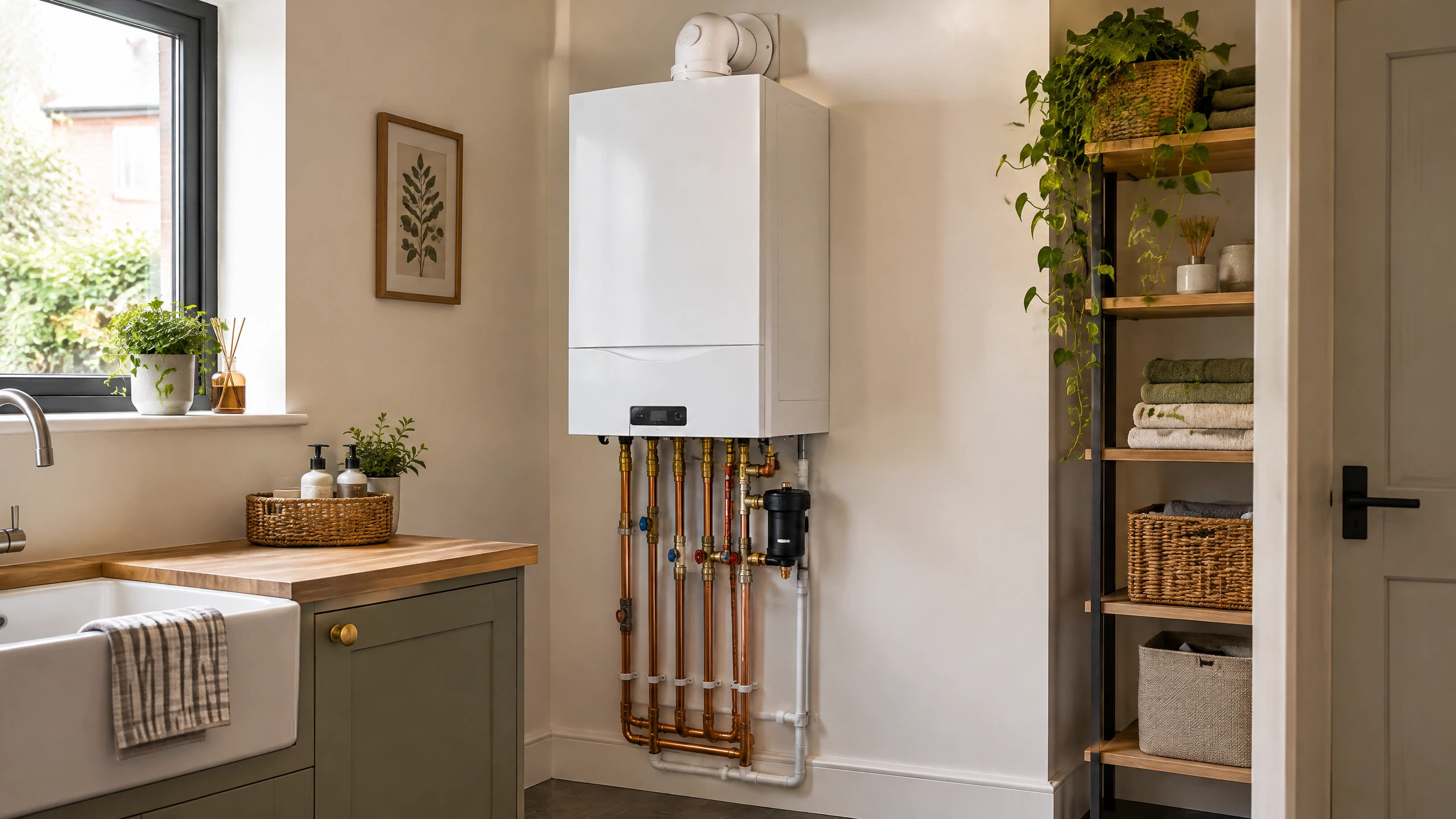
 Editorial image · For illustration only
**Short answer:** Navien says that a well-maintained boiler in a properly designed and installed system could be expected to last **up to 20 years or longer in some cases**. That is an expectation, not a guarantee or a fixed replacement date. A Navien combi-boiler's actual service life depends on maintenance, water quality, system design, installation, operating conditions, and the condition of its components.
For a Long Island homeowner, the practical question is not just the unit's age. It is whether the boiler is operating safely and reliably, whether the next repair is proportionate to the remaining service life, and whether a qualified professional can still support the equipment. Navien Boiler Services can evaluate those questions through [Navien boiler repair and installation service](/navien_boiler_repair_service_installations/).
What Navien's guidance says about lifespan
Navien's residential boiler FAQ identifies three major lifespan factors: how well the unit is maintained, the quality of the water passing through it, and how well the system is designed to work with the boiler. Navien also states that most of its boilers have a 10- to 15-year residential warranty, depending on the unit, while a properly maintained and correctly designed and installed system may last up to 20 years or longer in some cases.
A warranty period and a service-life estimate are different things. Warranty terms vary by product and may include separate coverage for labor, parts, and the heat exchanger. Coverage can also depend on the applicable warranty terms, installation, registration, maintenance, and other conditions. Check the warranty for the exact model rather than treating a general range as a promise.
Factors that affect a Navien combi-boiler's service life
Maintenance and cleaning
Regular professional maintenance helps identify combustion, condensate, venting, controls, pumps, seals, and heat-exchanger issues before they become larger failures. Navien's product documentation includes user information, installation manuals, service manuals, and maintenance instructions for specific series. Follow the manual for the installed model and use a qualified professional for internal service.
Maintenance is not a guarantee of a particular lifespan. It is risk management: it can help preserve safe operation, efficiency, and reliability, while giving the homeowner a clearer record of developing problems. Ask the service provider what was inspected, what was cleaned, what readings were taken, and what should be monitored next.
Water quality and hydronic-system condition
Water chemistry and debris can affect hydronic heating equipment. Poor water quality, untreated fill water, corrosion, scale, air, leaks, or inadequate system cleaning can place stress on heat-transfer surfaces and other components. The right corrective action depends on the system and the model; do not add chemicals or change system settings based on a generic internet recommendation. Have a professional assess the water and system condition against the manufacturer's instructions.
Design, sizing, and installation
Navien says system design matters. A boiler that is improperly sized, incorrectly piped, poorly vented, or not matched to the home's heat loss and domestic-hot-water demand may cycle excessively or operate outside intended conditions. Navien's FAQ explains that boiler sizing should be based on a heat-loss calculation and that a qualified contractor can perform that calculation.
A combi-boiler serves space heating and domestic hot water, so installation also involves flow, temperature, venting, condensate drainage, gas supply, and controls. A professional assessment is especially important when an older installation has recurring pressure, temperature, ignition, or hot-water complaints.
Operating environment and usage
Frequency of calls for heat and hot water, hard or contaminated water, freezing exposure, power interruptions, inadequate drainage, and blocked or altered venting can all affect reliability. These are general equipment considerations, not model-specific predictions. Your unit's manual and service history are the best sources for model-specific limits and procedures.
Repair or replacement: how to decide
Repair may be reasonable when
Repair is often worth evaluating when the problem is isolated, the heat exchanger and major structure remain sound, parts are available, the unit has a useful service history, and the repair restores safe, dependable operation. A younger unit with a documented maintenance history may be a repair candidate even when a component has failed.
Do not decide based only on the age of the boiler or on a single error code. The code identifies a condition to diagnose; it does not by itself prove that the entire appliance must be replaced.
Replacement deserves a professional evaluation when
Replacement becomes more compelling when the heat exchanger or core appliance has a major failure, unsafe venting or combustion cannot be corrected economically, failures are recurring, compatible parts or qualified support are difficult to obtain, the unit no longer meets the home's needs, or the total cost and disruption of repeated repairs outweigh the benefit of continued operation. A professional should compare the diagnosed repair with a correctly sized replacement and explain what existing piping, venting, electrical, gas, and condensate work may need to change.
There is no universal repair-dollar threshold that applies to every Long Island home. Labor access, diagnosis, code requirements, installation condition, system design, and the homeowner's reliability goals all matter. Request a written explanation of the failure, options, assumptions, and safety implications. For an installation assessment, see [Navien combi-boiler repair and installation service](/navien_combi_boilers_repair_service_installation/).
Warning signs that call for professional service
Contact a qualified heating professional if the boiler repeatedly locks out, loses pressure, leaks, makes unusual noises, fails to provide heat or hot water, shows recurring error messages, produces abnormal condensate, or has visible venting, wiring, gas, or water damage. A sudden loss of heat or hot water in freezing weather is urgent because plumbing and the home can be exposed to freeze damage.
If you smell gas, leave the area and follow your gas utility's emergency instructions. Do not operate switches, attempt a repair, or relight equipment unless directed by the utility or a qualified professional. If a carbon-monoxide alarm sounds, leave immediately and call emergency services from outside. Never bypass a safety control or open the cabinet to troubleshoot gas, combustion, electrical, or sealed-water components.
Navien cautions that its products involve water, electricity, and gas and that homeowner troubleshooting is limited. Its manuals warn that installation, maintenance, diagnosis, and repair should be performed by qualified professionals and that improper work may cause property damage, serious injury, death, or affect warranty coverage.
How to extend the useful life of a combi-boiler
Keep the model and serial number, installation date, warranty documents, service records, and error history together. Keep the area around the boiler accessible and follow the model's instructions for clearances and user checks. Do not block intake or exhaust terminations, modify venting, or store combustible materials near the appliance.
Schedule maintenance according to the installed model's manual and the service professional's recommendations. Have recurring faults diagnosed rather than repeatedly reset. During a service visit, ask the technician to review water quality, pressure, condensate, venting, combustion, heat transfer, controls, circulators, and the system's overall design as applicable.
If domestic hot water is the concern rather than space heating, a professional may need to determine whether the issue is in the combi-boiler, fixtures, water quality, controls, or the broader plumbing system. Navien Boiler Services also provides information about [Navien water-heater repair and installation](/navien_water_heaters_repair_service_install/).
Related homeowner questions
Is 20 years guaranteed for a Navien combi-boiler?
No. Navien's wording is that a well-maintained boiler in a properly designed and installed system could last up to 20 years or longer in some cases. It is not a guaranteed lifespan, warranty promise, or model-specific forecast.
Does a 10- to 15-year warranty mean replacement is due then?
No. The warranty range is coverage information, not an automatic end-of-life date. Read the warranty for the exact model and consider condition, safety, repair history, parts support, and performance.
Can a homeowner clean or repair the boiler?
A homeowner can perform only the user-level checks allowed by the model's documentation. Internal cleaning, combustion work, gas work, electrical diagnosis, venting changes, and repairs should be left to qualified professionals. Navien says internal components should be serviced by a qualified contractor.
Where does Navien Boiler Services work?
For service planning in Long Island, review the [areas we serve](/areas-we-serve/) and request a [free estimate](/free-estimates/). Availability, system condition, and the scope of work should be confirmed before scheduling.
Sources
1. [Navien Residential Boilers FAQ](https://www.navieninc.com/residential/boilers/faqs) 2. [Navien Residential Products: boiler lifespan guidance](https://www.navieninc.com/residential) 3. [Navien Residential Condensing Combi-Boiler Warranty Information](https://www.navieninc.com/residential/combi-boilers/warranties) 4. [Navien NFC-H Downloads, manuals and service-document safety warnings](https://www.navieninc.com/series/nfc-h/downloads) 5. [U.S. Department of Energy: Purchasing Energy-Efficient Boilers](https://www.energy.gov/cmei/femp/purchasing-energy-efficient-boilers)
This article is general homeowner information, not a diagnosis or a substitute for the installed model's manual, applicable codes, or an on-site evaluation by a qualified professional.